
Physical activity is necessary for optimal health.
Why is physical activity important?
Physical activity is a necessary requirement for optimal health as it helps with both intellectual and physical development. Regular physical activity in childhood helps to develop cardiovascular fitness, muscle strength and bone density. Children who are more active are also found to have:
- Improved academic performance.
- Improved sleep and more energy.
- Decreased stress and anxiety.
- High self-esteem.
Why are kids less active today?
Today, kids spend less and less time moving and being active and more time being sedentary. With hectic schedules and long commutes, families find themselves with less time devoted to both structured and unstructured play.
How much physical activity does my child need?
The new Canadian 24-Hour Movement Guidelines recommend that children aged five to 17 accumulate at least 60 minutes of moderate to vigorous physical activity each day. Vigorous physical activity and muscle strengthening activities should be incorporated at least three days per week. With physical activity, more is always better. Here is a visual guide:
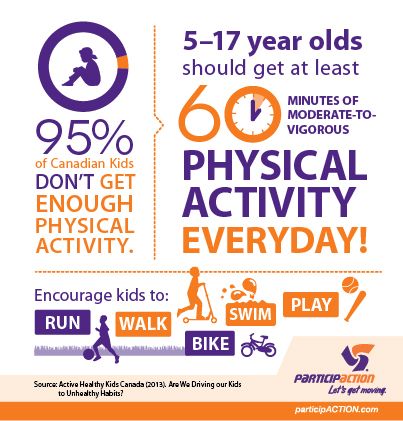
In order to ensure your child maintains optimal health, every day they should get:
- Several hours of lightly structured and unstructured physical activities.
- Nine to 11 hours of sleep for children five to 13 years of age.
- Eight to 10 hours of sleep for children 14 to 17 years of age.
- Consistent sleep and wake times.
- No more than two hours of recreational screen time.
- Limited periods of sitting.
How can I support my child to be active?
There are many ways to get active, and the goal is to enjoy moving in ways that feel good, build confidence and support overall well-being. All adults in a child’s life can act as role models. The best way to support your child is to get active with them. Ideally, activity will take place throughout the day to limit sedentary time. Here are some ideas:
- Make family time active time.
- Encourage walking or biking to school and around your community (to a friend’s house, a store, etc.). Even parking and walking or rolling some of the way of a commute helps youth get active.
-
Provide opportunities for both structured and unstructured play.
- Playgrounds and outdoor unstructured play are great ways to build physical literacy skills while getting active and having fun. Take kids to the playground or park to play.
- Provide simple toys like skipping ropes, hula hoops, balls and racquets.
- Ensure your child has the proper clothing to play outside no matter the weather.
- Replace screen time with outdoor play.
- Have them help you with daily active chores (washing the floor, raking leaves, carrying groceries).
- Participate in a story walk. You can find them in many municipalities, including White Rock, Delta, Langley and Chilliwack.
-
Try out a new recreational program in your community. There are grants available to families that may help with the costs of sports and recreation programming:
- Jumpstart Individual Child Grants
- ISPARC RISE Individual Grants
- KidSport Grants
- When using screens, choose options that encourage activity, such as geocaching.
- Encourage children to choose follow‑along movement videos as an alternative to sedentary screen time.
Resources
- ParticipACTION: Make room for play
- HealthLink BC: Physical activity services
- Public Health Agency of Canada: Tips to get your children aged five to 11 active
- Unstructured play