
Information and resources for community organizations.
Last updated: May 14, 2026.
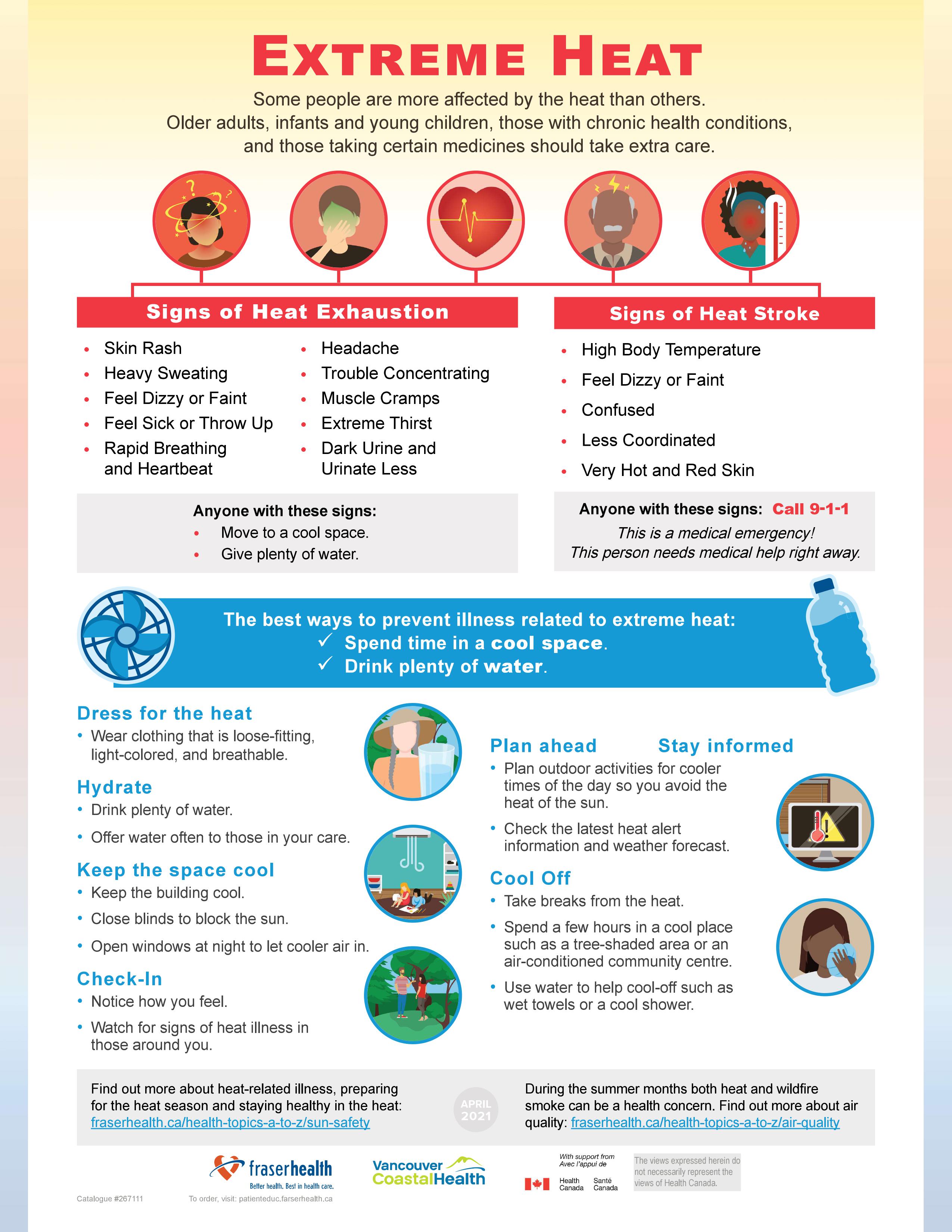
Download extreme heat poster PDF.
Translated content: English, Arabic, Chinese - Simplified, Chinese - Traditional, Hindi, Korean, Farsi, Punjabi, Spanish, Urdu and Vietnamese
Summer heat can pose serious health risks to people who are unhoused, or living in precarious and/or poor-quality housing that is prone to overheating, especially those with pre-existing heart, lung or mental health conditions.
Organizations that work with these community members are encouraged to have pre-season and post-season plans for staff and peer outreach on vulnerability, how to spot heat illness, what can be done to keep people cool, and what to do if the think someone is experiencing heat illness.
-
Identifying who is at risk
Everyone is at risk of heat-illness during extreme temperatures; however, groups at higher risk include:
- People who are unhoused.
- People who experience psychiatric conditions, particularly schizophrenia.
- People who use certain medications (including some psychiatric medication).
- People who use substances.
- Older people.
- People living alone or who are socially isolated.
- People without access to air conditioning (Government rebates for air conditioning or cooling retrofits may be available; the BC Hydro air conditioner program is open to those attached to Health Authority Mental Health and Substance Use Teams).
- People with chronic illnesses (such as breathing difficulties, heart conditions).
- People who work or exercise in the heat.
- People who are pregnant.
- Infants and young children.
Know the signs and symptoms of heat illness and how to respond (read and share heat poster above).
Extreme heat planning
-
Before heat events
- Complete a heat action plan.
- Recommended actions for each warning level can be found through the BC Heat Alert and Response System (BC HARS).
- Extreme heat and wildfire smoke plan templates for non-profit housing providers are available through BC Housing and can be adapted to support our unhoused neighbours.
- Fraser Health can provide feedback on these plans (healthybuiltenvironment@fraserhealth.ca).
- Alert levels are:
-
Warning Level
Yellow Warning - Heat
Orange Warning - Heat
Red Warning - Heat
General Criteria
Unusually high daytime and overnight temperatures for 2+ days
Very high daytime and overnight temperatures for 3+ days
Orange warning conditions with temperatures rising each day for 3+ days
Expected frequency
~3 times per summer including the first heat event
~once per summer
~once per decade
Expected indoor temperature without air conditioning
Elevated daytime and overnight low temperatures remaining stable day-over-day
Very elevated daytime and overnight low temperatures remaining stable day-over-day
Very elevated daytime and overnight low temperatures increasing day-over-day
-
Community partners are encouraged to activate their response at all warning levels to the best of their ability and capacity. Key suggested actions include:
- Insure staff and volunteers are prepared to monitor extreme weather using the following:
- Download the WeatherCAN app .
- Sign up for Metro Vancouver email air quality alerts .
- Monitor the Air Quality Health Index (AQHI) in your area.
- Check air quality from regulatory and non‑regulatory low‑cost sensors in your area using the BC AQ Map .
- Identify clients who may be most vulnerable and consider check‑in plans as capacity allows.
- Ensure all volunteers and staff review Fraser Health’s heat‑related information, including signs and symptoms of heat illness.
-
Share resources for people who may use substances or who have mental health challenges, or support people who use substances on how to stay safer during heat events.
- Posters can be displayed in common areas or distributed in the community.
- Resources can be included in cooling kits if your organization has the capacity to provide them.
- Connect with your local government to participate in heat‑planning tables where possible. Local governments may partner with community organizations or share funding from provincial grants. Investigate whether your organization can provide a cooling space or cool room . If not, identify cooling spaces available in your community.
- Attend or watch seasonal preparedness webinars from Fraser Health and Vancouver Coastal Health (recordings available on YouTube; links below).
- Sign up for Fraser Health’s extreme weather update listserv: healthyenvironments@fraserhealth.ca.
- Insure staff and volunteers are prepared to monitor extreme weather using the following:
- Complete a heat action plan.
-
Guidance and resources for service providers and peers
Posters and resources
- Prepare for Extreme Heat Events – Health and service providers.
- Prepare for an Extreme Heat Event : A guide for people who use substances.
- Prepare for Extreme Heat : A guide for people living with schizophrenia.
- Supporting people living with schizophrenia during extreme heat .
- Prepare an extreme heat kit .
- Stay safe during extreme heat events .
- Using substances during extreme heat .
- Getting prescriptions and carries during extreme weather .
- Medications and heat
- Public health guidance for homeless encampments
Fraser Health and Vancouver Coastal Health webinars on seasonal readiness
-
The 2026 webinar included
:
- SRO Collaborative: Indoor temperatures and community recommendations
- Provincial Psychosocial Services Education: Climate anxiety resources
- VCH Public Health: Tips from the Outreach Team
-
The
2025 webinar
included:
- University of British Columbia: Surviving the heat with schizophrenia – lessons from qualitative interviews
- Metis Nation BC: Impacts and lessons learned from interactive extreme weather and emergency workshops
- VCH and West Vancouver Library: AQ‑CARE – Air Quality, Community Action, Resilience, and Empowerment
-
Previous webinars
- Collingwood Neighbourhood House in Vancouver share their education and outreach programs to support communities during heat waves (11 minutes).
- Eastside Illicit Drinkers Group for Education share their community amenity map, stewardship work, and hydration tent during heat emergencies (22 minutes).
- BREATHE shares their do‑it‑yourself air cleaner workshops and free online resources (14 minutes).
- MOSAIC shares advocacy and programs supporting migrant workers impacted by summer heat emergencies (20 minutes).
- Aboriginal Housing Management Association shares findings on extreme heat among urban Indigenous households in B.C. and recommendations for community support (22 minutes).
-
During a heat event
Heat warnings are announced through the media or the WeatherCAN app . Organizations can sign up for early warnings through ECCC (meteopac@ec.gc.ca).
Though all events are dangerous for people who are vulnerable, heat events at the start of the summer (May–June) are more dangerous than those near the end (August), once people are acclimatized.
Organizational actions during a heat event:
- Activate the components of your plan that correspond to the level of heat warning.
- Increase outreach and communication about risks, as capacity allows.
-
If there is capacity, check in on vulnerable clients or community members when temperatures start to climb, remembering that indoor temperatures can be more dangerous than outdoor temperatures.
- The risk of heat-related illness may increase at indoor temperatures over 26°C (78°F) and may significantly increase at indoor temperatures over 31°C (88°F), especially for people at higher risk.
The following resource may be useful: Heat Check-in Support Framework for Non-governmental Organizations (Fraser Health / Vancouver Coastal Health).
- Training video: Developing a check-in system .
- Training video: Extreme heat check-in training (Vancouver Coastal Health).
- Guide for in-person or remote extreme heat check-ins (National Collaborating Centre for Environmental Health).
- Translated content: English, French, Chinese (simplified).
- Be aware of outdoor resources such as water fountains, which can be found on TapMap (metrovancouver.org) .
-
If possible, create a cooling room or
cooling space
where clients can socialize and cool off. This may require portable air conditioning or building modifications.
- This resource also includes information about accessibility and pet-friendly shelters.
-
Make and share a list of places in the neighbourhood with air conditioning or shade that can be used as cooling shelters.
- Community centres, libraries and shopping malls.
- Depending on your local government, cooling centres may be listed on a website, the Government of B.C. portal , or on social media. If these are far from where clients live, provide transportation passes where possible.
- Cooling shelters operated by non-governmental organizations may be found on BC211.
- For red-level events, increase outreach and communications and, where possible, extend the operating hours of cooling shelters.
-
Sustained cooling strategies
- It can take time to dissipate body heat and recover.
- Once overheated, it can take many hours for a person to cool their body fully after coming to a cool space.
- If they leave the cool space, body temperature can return to dangerous highs very quickly.
- People can absorb a lot of heat in walking or taking transit to a cooling centre.
- If overnight temperatures are warm:
- Heat may build indoors over time.
- Health effects are worse because there is limited recuperation from the day’s heat.
- For these reasons, outreach strategies and cooling strategies near where people already are can be very important, along with providing resources for longer hours or overnight.
- It can take time to dissipate body heat and recover.
-
How to create an outdoor cooling centre
From 2020 BC Centre for Disease Control Guidance:
*Be aware that indoor cooling spaces are preferred to make a difference for the health and safety of clients; however, outdoor cooling and misting tents may increase comfort for clients and staff.
- Provide 100 per cent shade within its designated boundaries.
- Cooling:
- Passive measures (natural breezes): Promoting air circulation using passive measures will increase the cooling abilities of an outdoor space. If setting up a cooling space in an urban environment, consider choosing locations where natural breezes occur to promote air circulation.
- Active measures (fans and evaporative coolers): Setting up fans in outside cooling spaces to increase airflow may make cooling more effective for visitors; however, at or above 35°C, fans may worsen heat-related illness. Evaporative coolers are a good option for outdoor cooling centers in urban spaces because they cool the air. They cost between $100-$500.
- Misting tents with good ventilation are also an option to make people more comfortable; however, it is not clear the degree to which they reduce heat-related illness mobility and accessibility:
- Have wheelchair accessible locations for cooling spaces.
- Have communications material offered in different languages in outdoors and outdoor cooling spaces for community members, which may include:
- Have designated areas for individuals to sit with pets.
- Require that all dogs must be on a leash while within the outdoor cooling center.
- Consider providing a water bowl for dogs to cool off as well.
- Working with partners:
- o Where possible let bylaw officers and first responders in your municipality know that you are opening a cooling space, so they can direct people to the space.
Further information on creating outdoor cooling spaces can be found here.
-
Wildfire smoke
Wildfire smoke is becoming more common in our communities. Breathing in smoke can affect health, especially among those most vulnerable. People most vulnerable to the health impacts of smoke include those with pre‑existing lung and heart conditions, diabetes, pregnant people, older adults, children, and those with higher exposure, such as clients who may spend all or large portions of their day outdoors.
As of 2026, air quality warnings follow a yellow‑ and orange‑colour‑coded alerting system. These colours are different from the Air Quality Health Index (AQHI).
Some ways to support clients are:
- Sign up for alerts, as noted above.
- Post this wildfire smoke poster in places where staff and clients may see it. It summarizes health risks and actions to reduce smoke exposure.
- If clients are experiencing symptoms, support them to spend time in indoor spaces with cleaner air and seek medical care if needed.
- Check the Air Quality Health Index (AQHI) . The AQHI provides air quality ratings for communities and can help identify when clients may be most affected.
- Support people to spend time in indoor spaces that offer relief from smoke, particularly large, air‑conditioned spaces, as these are more likely to have filtered air. If capacity allows, consider creating a clean‑air space where clients feel welcome and comfortable.
- Masks to protect against smoke are recommended only in specific situations, such as for people working outdoors who have access to well‑fitting, high‑efficiency masks (N95, KN95 or KF95). See this factsheet from the BC Centre for Disease Control for guidance.
- The Red Cross may be able to provide free N95 masks to eligible organizations .
-
Mental health considerations
Extreme temperatures correlate with increases in mental health–related emergency department visits, globally and in the Fraser Health region. Some medications, including antidepressants and antipsychotics, can increase the risk of overheating. Some people may also use substances to cope with extreme weather and may isolate more during these events.
Checking on those dealing with severe mental health challenges is recommended.
Additionally, as extremely hot weather can provoke suicidal thoughts in some people, alert clients, volunteers and staff to check on those who might be at risk.
- Where possible, clients who may experience or be at risk of suicidal ideation can be referred to Fraser Health mental health services to support co‑creation of care plans.
- If someone is experiencing a mental health emergency that is not life‑threatening, please call:
- Fraser Health Virtual Health at 1‑800‑314‑0999.
- Crisis line for adults: 604‑951‑8855 or toll‑free 1‑877‑820‑7444.
- Aboriginal Health Culturally Sensitive Services: 1‑800‑KUU‑US17 (1‑800‑588‑8717) or Métis Crisis Line: 1‑833‑638‑4722.
- Information on resources and services through the First Nations Health Authority can be found here .
More resources on suicide and self‑harm can be found here .
During the 2021 heat dome, people experiencing schizophrenia represented 16% of deaths. Research is continuing to better understand these vulnerabilities. Resources are available above, and recent webinars from the UBC School of Population and Public Health provide helpful information.
- Extreme heat and schizophrenia: A complex and risky combination ; Dr. Sarah Henderson et al. (March 2026)