June is Stroke Awareness Month. At Royal Columbian Hospital, clinical teams are using advanced imaging technology to help younger stroke patients live healthier lives.
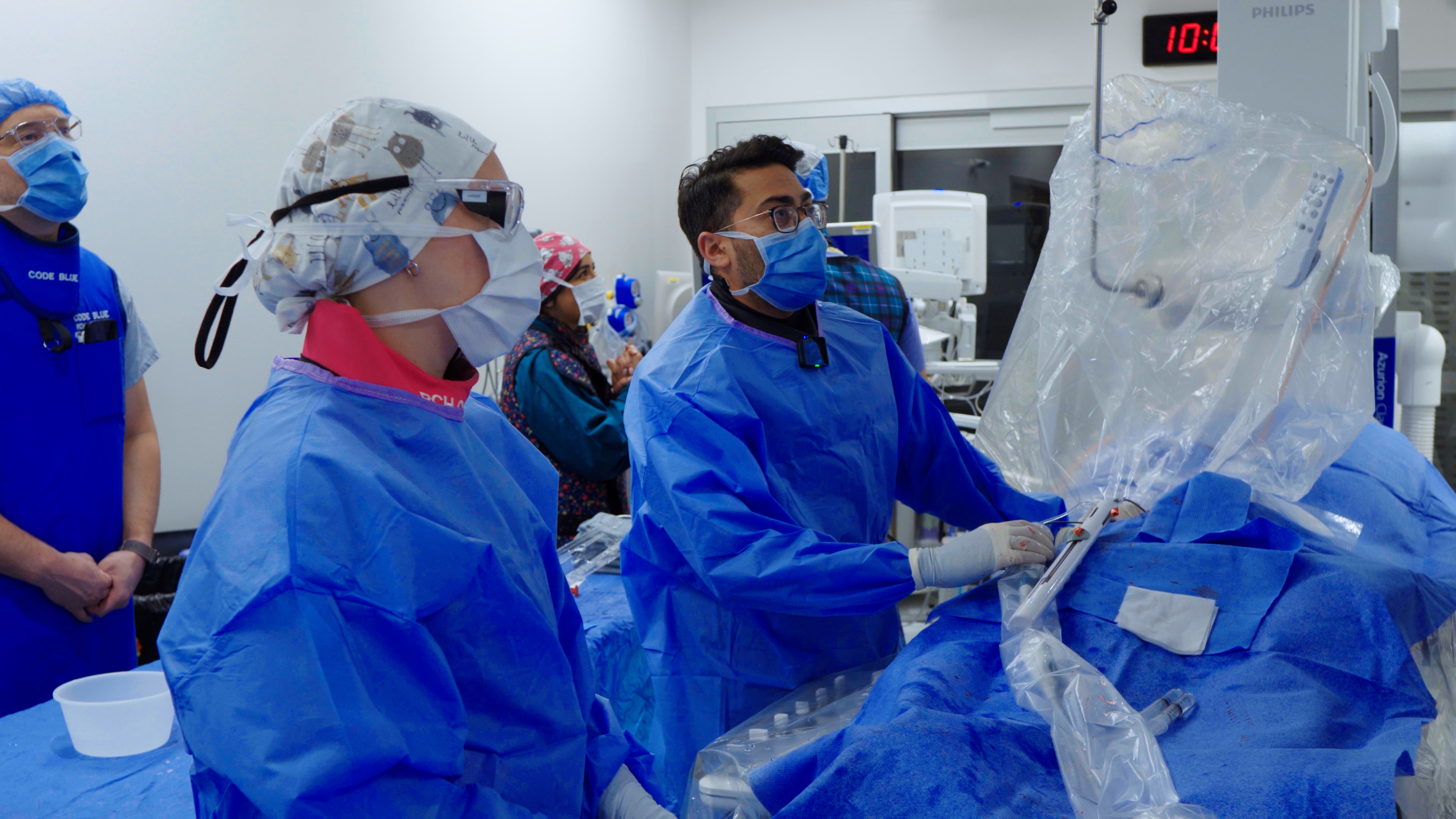
(Photo) Dr. Razi Khan and Royal Columbian Hospital surgical teams repair a hole in Collin Smith’s heart.
Collin Smith will never forget the morning he had a stroke.
“It was last fall and I was warming up our car while my wife buckled our daughter into her car seat,” says the 37-year-old Maple Ridge resident.
“My fingers started going numb and my face felt like it was drooping,”
Collin was treated by the regional stroke team at Royal Columbian Hospital. At first, his symptoms pointed to a transient ischemic attack (TIA), or mini-stroke, where blood flow to the brain is temporarily blocked and symptoms typically resolve within 24-hours.
Further testing revealed something more serious. Collin had suffered a stroke and had a hole in his heart, known as a patent foramen ovale (PFO). While a PFO is common and usually harmless, it can allow small blood clots to travel to the brain, causing a stroke.
“We know that PFO is linked to stroke in relatively young adults,” says Dr. Razi Khan, interventional cardiologist at Royal Columbian Hospital. “If we can detect and close PFOs and monitor the effectiveness of doing so, we can reduce the risk of subsequent stroke in people under 60 by 40-to-50 per cent over the course of their lifetime.”
On April 29, Dr. Khan, along with Dr. Greg Walker, interventional neurologist, and the cardiac team at Royal Columbian Hospital repaired the hole in Collin’s heart with a small, implanted device resembling an Oreo cookie.
Watch clinical teams repair the hole in Collin’s heart
The minimally invasive procedure was done while Collin was awake. Advanced imaging technology — known as robotic assisted transcranial Doppler (robotic TCD) — was placed around Collin’s head to measure blood flow to his brain.
The technology combines artificial intelligence and robotics and is more sensitive than traditional methods, helping to detect even very small openings around the heart that may otherwise go unnoticed.
“Robotic TCD helps us better understand the communication between the left and right side of the heart — known as residual shunting — and by eliminating it, we can more effectively reduce the risk of future strokes,” says Dr. Walker. “It also eliminates the need for more invasive testing.”
Royal Columbian Hospital is among the first in Canada to use this technology in stroke care.
“Every donation helps create opportunities to advance patient care through innovation,” says Jeff Norris, president and CEO, Royal Columbian Hospital Foundation. “The transcranial Doppler used in Collin’s care was made possible through donor support and is one example of how philanthropy helps equip Royal Columbian Hospital with the tools and technology needed to deliver specialized treatments and improve outcomes for patients.”
Fraser Health sees 37 per cent of all stroke occurrences in the province and the volume is expected to increase to 40 per cent by 2040.
Collin has now recovered from his stroke and is grateful to be living in an era where early interventions will give him the best chance at a healthy life.
“Technology is moving so quickly,” he says. “It’s a relief to know that this may help prevent a future stroke and possibly even assist with some of my other health issues.”