
Two Fraser Health teams have received Michael Smith Health Research BC awards to support research aimed at strengthening care for older adults living at home.
Many older adults want to remain in their own homes as they age. While this is not always possible without support, innovative research and partnerships are helping bridge the gap between new evidence on aging well and everyday health care practice.
Health Research BC’s Advancing the Use of Evidence in Seniors’ Home and Community Care program brings together health authorities, researchers, care providers, people with lived experience and community partners to turn research into meaningful change for older adults and their families.
“Hosting two of five Health Research BC awards is a tremendous honour for Fraser Health and a powerful vote of confidence in our work,” says Kate Keetch, director, Department of Evaluation and Research Services. “To see these initiatives evolve so more older adults in B.C. can live well in their own homes is a testament to the passion and dedication of the research teams, and an example of how research truly is care.”
Fraser Health funded projects
Scaling up social prescribing to support seniors’ well-being
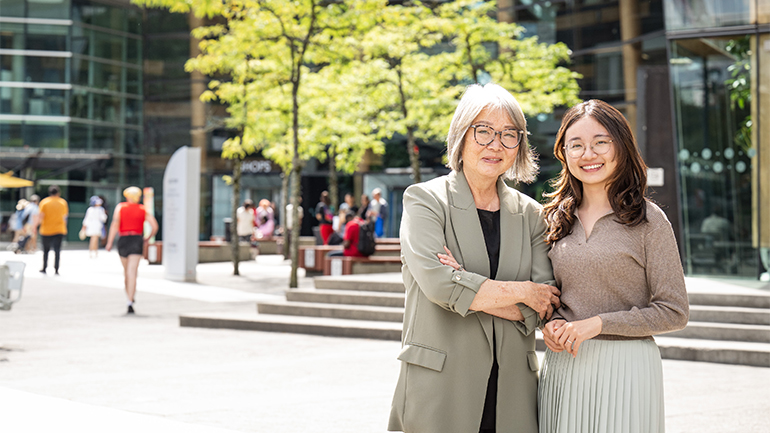
Photo: Dr. Grace Park, project co-lead, Fraser Health; Margaret Lin, regional project lead, Fraser Health. Photo provided by UBC Faculty of Medicine. Credit: Martin Dee Photography.
We’re used to getting prescriptions for illness, but how about a prescription for wellness?
This novel concept, known as social prescribing, allows health care professionals to refer older adults to community connectors who link them to non-clinical services such as physical activity programs, social opportunities and nutrition services. More than 30 countries worldwide have joined the social prescribing movement.
“Social prescribing is now in place in 30 countries and is a global movement,” says Dr. Grace Park, project co-lead. “Social health is a huge part of health, especially for older and more vulnerable people. In health care, we’re often just dealing with medical issues. When seniors meet with a community connector through social prescribing, different concerns come up—such as fear of becoming homeless because of rising rent costs—issues that have a huge impact on their lives but don’t usually surface when talking to a physician.”
First launched in partnership with the United Way in 2019 as a demonstration project, “the little pilot project that could” has grown significantly with more than 3,000 people connected and 21 community connectors in the Fraser Health region alone.
With $1.3 million in new funding from Health Research BC and the Province’s investment in community-based seniors’ services administered by United Way BC, the project team will collaborate with BC universities, other health authorities and community partners to evaluate the impact of social prescribing on older adults and the health system, and strengthen partnerships between the health system and community partners.
“Together with Fraser Health and our community partners, this research investment will help advance social prescribing across B.C., ensuring more older adults are connected to the programs and relationships that support their well-being,” says Bobbi Symes, director, Healthy Aging, United Way British Columbia.
“In Fraser Health, we’ve been able to build a bridge between the health system and the community,” says Margaret Lin, project co-lead and regional project lead. “It’s a beautiful thing because every health authority’s program will look a little different to best support their communities and we will be able to share our learnings to support social prescribing across B.C.”
Supporting Indigenous caregivers and Elders at home
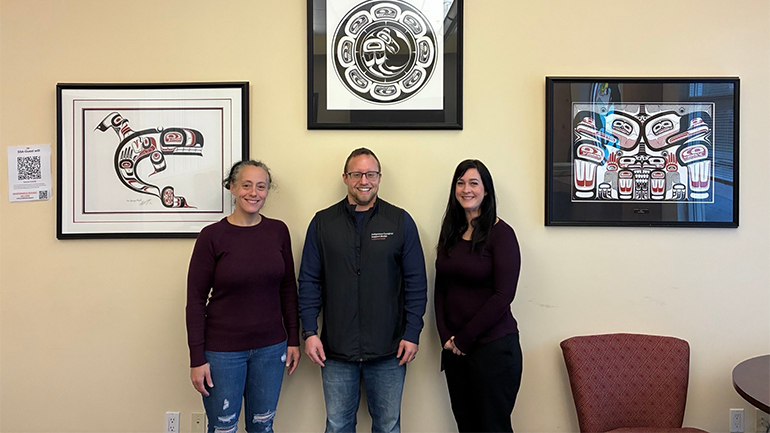
Photo: Indigenous Caregiver Support Model Clinical Team: Carrie Mastin, licensed practical nurse; Ryan Stone, clinical resource nurse; Rebecca Lundin, licensed practical nurse.
ICSM is a culturally grounded, home-based program that supports Indigenous Elders with complex needs to age safely at home and in their community. Through the program, caregivers receive skills training and an honorarium to help reduce the economic strain of caregiving. Elders receive regular home visits from Indigenous-led clinical teams who provide culturally safe, relationship-based care, rooted in trust, kindness and respect.
Launched as a pilot in 2023, the project has supported 33 Elders and their caregivers in Fraser East. With $1.3 million in new funding from Health Research BC, the program—co-designed by Fraser Health Indigenous Health, Stó:lō Service Agency, First Nations Health Authority and Métis Nation British Columbia—will benefit even more Elders and caregivers in Chilliwack.
“This model is an example of what is possible when care is built on relationships, trust and community,” says Amanda LaBoucane, interim vice president, Indigenous Health and Cultural Safety. “Many Elders and caregivers in the Chilliwack area have experienced firsthand the impacts of residential schools and the child welfare system. By strengthening caregiver capacity and confidence while bridging into integrated clinical care teams run by and for Indigenous people, we see improved health and wellness and stronger relationships within and between communities.”