

Helping you make sense of alcohol and your health.
We now know that even small amounts of alcohol can increase health risks over time.
Alcohol can lead, or contribute, to many health problems, including cancer and heart disease. Day to day, it can affect your mood, your energy and your sleep.
How much you drink and how often you drink both matter.
Drinking less—and less often—can lower your risk of harm.
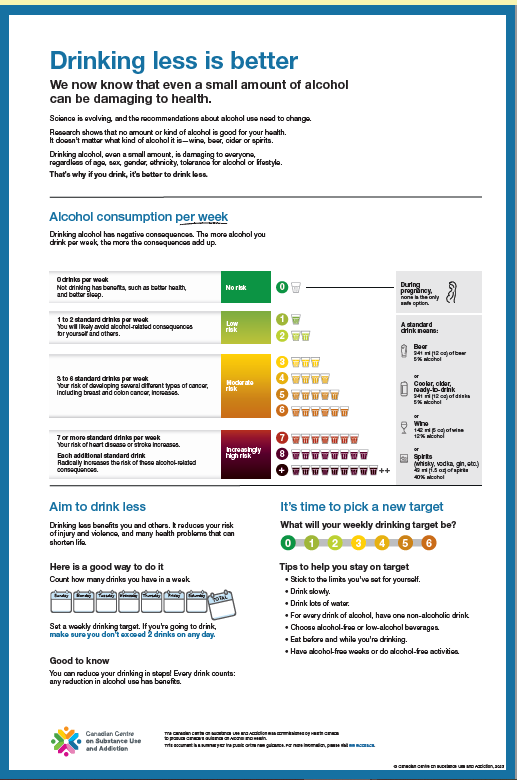
Canada’s Guidance on Alcohol and Health, Canadian Center on Substance use and Addiction: Drinking Less Is Better (Infographic)
There is no amount of alcohol that is good for your health, and the type of alcohol does not matter. Wine, beer, cider, and spirits all carry similar risks.
If you choose to drink, cutting back can make a real difference to your health. Want to drink less? Check out these supports.
Health risks of drinking alcohol
-
Alcohol and cancer
Cancer is the leading cause of death in Canada. Alcohol is a carcinogen, meaning it can cause cancer.
Alcohol increases the risk of at least seven types of cancer, including cancers of the:
- Breast
- Colon and rectum
- Mouth
- Throat
- Esophagus
- Larynx
- Liver
In Canada (in 2022), alcohol use was found to be causal to more than 9,000 cases of cancer with over 3500 deaths. Drinking as little as three standard drinks per week can increase your risk of cancer.
-
Alcohol and heart disease
Heart disease is the second leading cause of death in Canada.
Alcohol is not good for your heart.
In the past, people believed that drinking small amounts of alcohol could protect heart health. New research shows this is not true.
Drinking small amounts of alcohol does not protect against heart disease.
Drinking more alcohol increases the risk of:
- Heart disease and heart attacks
- High blood pressure
- Heart failure
- Irregular heart rhythms (such as atrial fibrillation)
- Stroke
Drinking seven or more standard drinks per week increases the risk of heart disease and stroke.
-
Alcohol and liver disease
Alcohol causes harm to the liver.
When your liver breaks down alcohol, some liver cells are damaged or destroyed. While the liver can repair itself, drinking too much alcohol over many years makes this harder.
Alcohol can lead to:
- Fatty liver disease
- Liver inflammation
- Permanent scarring (cirrhosis)
- Liver cancer
-
Alcohol, injury and violence
Alcohol use is often linked to injuries and violence.
Alcohol can increase:
- Aggressive and violent behaviour
- Intimate partner violence
- Sexual violence
- Serious injuries from falls or crashes
- Self-harm
Higher levels of alcohol use also increase the risk of road injuries and other accidents.
Avoiding drinking to intoxication can reduce these risks.
-
Alcohol use disorder
Drinking alcohol regularly can change how your body reacts to it.
Over time, you may need to drink more to feel the same effects. This is called tolerance.
Some people may develop alcohol use disorder, which can affect:
- Physical and mental health
- Work or school
- Relationships
- Finances
- Legal safety
Mixing alcohol with other substances or medications can lead to unpredictable effects that can be life threatening.
-
Should some people completely avoid alcohol?
Some people should not drink alcohol at all, including:
- Children and youth
- People who are pregnant
- People who are breast or chest-feeding
- People taking medications or other substances that interact with alcohol
- People who are driving or operating machinery
- People who want to fully avoid alcohol related health risks