Patients undergoing breast surgery at Royal Columbian Hospital are benefiting from an innovative new approach.
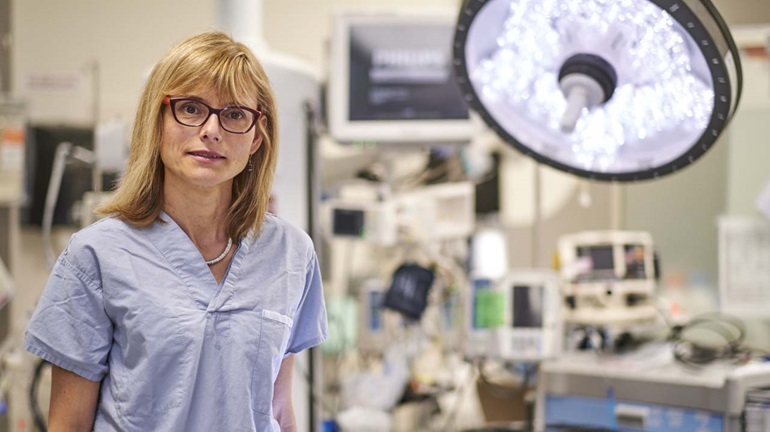
(Photo) Dr. Michelle Goeke at Royal Columbian Hospital. Photo courtesy of the Royal Columbian Hospital Foundation.
At Royal Columbian Hospital, a new approach has been introduced to help make the breast surgery experience more comfortable for patients.
During a surgery when a breast lesion can not be felt, a marker is needed to help guide the surgeon. Traditionally, this was done by placing a wire on the day of the surgery.
“It’s effective, but can be uncomfortable for patients,” says Dr. Michelle Goecke, General, trauma and breast surgeon, Royal Columbian Hospital. “You’re coming in early, having a wire placed and then waiting for surgery with something protruding from your body.”
To improve the patient experience, the team introduced seed localization, an alternate approach that uses a tiny marker, smaller than a grain of rice, to guide the surgeon.
With this approach, the seed can be placed days in advance. Patients can leave after the procedure, go about their day and return later for surgery.
“It’s a much shorter, simpler day,” says Dr. Goecke. “Patients just come in for their surgery instead of coordinating multiple steps all at once.”
Royal Columbian Hospital was the first site in B.C. to introduce seed localization for breast surgery. What began as a physician-led quality improvement initiative has continued to evolve with new technology, as teams explore expanding the approach to other sites across Fraser Health.
The Royal Columbian Hospital Foundation has supported the program’s evolution through donor-funded equipment at key stages. Beginning with specialized equipment for seed localization in 2019, that support continued with specimen radiography technology in 2021 and, most recently, equipment funded by the Royal Columbian Hospital Auxiliary in 2025 to support the transition to magnetic seed localization.
“This program is a powerful example of how philanthropy helps bring innovation into health care,” notes Royal Columbian Hospital Foundation President and CEO Jeff Norris. “Over time, innovations like these can become the standard of care, but they often begin because generous donors are willing to invest in new ideas and new possibilities for patient care.”
The innovation is also helping care teams work more efficiently. With wire localization taking place on the day of surgery, operating room schedules need to be closely coordinated with imaging appointments.
“With wires, everything has to line up perfectly,” says Dr. Goecke. “With seeds, teams can start earlier and treat more patients in a day.”
That flexibility is making a meaningful difference. Patients are moving more quickly from consultation to surgery, with wait times reduced by nearly two weeks. Shorter procedures are also helping teams care for more patients each day.
“This work shows how rethinking even one step in care can make a meaningful difference,” says Lesli Matheson, Executive Director, Clinical Quality and Patient Experience. “By moving away from wires to a more flexible approach, teams are improving the experience for patients while also making better use of time in the operating room.”
The work has been highly collaborative, bringing together teams in radiology, surgery and pathology to test and refine the approach.
Ultimately, the outcome is a win-win for patients and care teams, helping support a more comfortable, flexible and timely care experience.