
Every year when Verna and Doug Platt turn on their furnace, they remember the day a carbon monoxide detector saved their lives. On January 8, 2022, the couple wasn’t feeling well during a power outage. Their neighbour brought over supplies, and, just in case, a carbon monoxide detector.
Later, an alarm sounded, warning of dangerous levels of carbon monoxide in their home. The Platts were already experiencing symptoms of carbon monoxide poisoning but were able to get outside and receive treatment in hospital.
“I encourage everyone to have working carbon monoxide detectors, and to check the shelf life because they do expire,” says Verna Platt.
Carbon monoxide is an invisible, odourless and tasteless gas produced by fuel-burning appliances. Because it cannot be detected without an alarm, every home should have working carbon monoxide detectors.
In addition to two carbon monoxide detectors in their home, the Platts now have their furnace, fireplace and other fuel-burning appliances inspected annually.
If fuel-burning appliances malfunction or are not venting properly, carbon monoxide levels can build up. In the Platts’ case, corrosion in their furnace’s secondary heat exchanger caused incomplete combustion and dangerous levels of carbon monoxide to build up inside the home.
While carbon monoxide itself has no smell, homeowners may sometimes notice a strong vinegar-like odour caused by other combustion by-products known as aldehydes. In the Platts' case, neighbours reported smelling what they thought was natural gas but turned out to be aldehydes.
"Anyone can be affected by carbon monoxide poisoning without realizing it," says Dr. Emily Newhouse, medical health officer, Fraser Health. "Symptoms may develop gradually or come on quickly, which is why prevention and early detection are so important."
Symptoms of carbon monoxide can include:
- Dizziness
- Shortness of breath
- Fatigue
- Nausea or vomiting
- Chest pain
- Confusion
- Headache
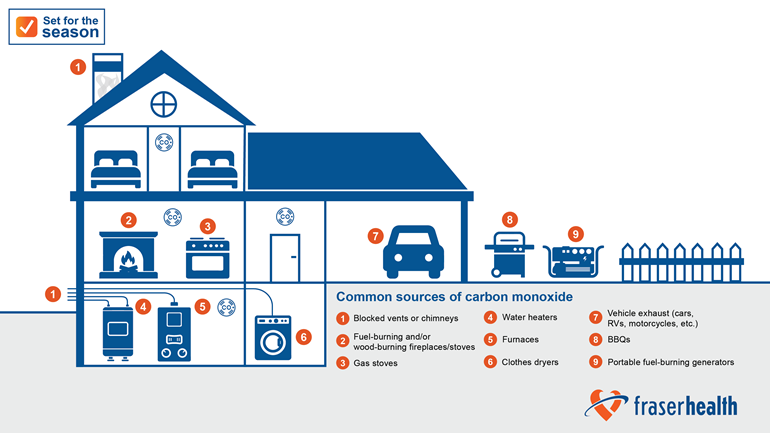
Dr. Newhouse recommends having a Canadian-certified carbon monoxide alarm on every floor of your home and near sleeping areas. Test alarms monthly and replace batteries as needed.
Natural gas and propane appliances, including furnaces, fireplaces, water heaters and stoves, should be inspected annually by a licensed gas contractor. Similarly, wood-burning appliances should be inspected annually by a certified wood-burning appliance inspector to identify potential safety issues that can lead to not only carbon monoxide buildup, but also chimney fires. Outdoor appliances such as barbecues, generators and camping stoves should never be used indoors, even during a power outage. Vehicles should not be left idling in a garage, even with the door open.
“If your carbon monoxide detector alerts, or if you experience symptoms you think could be related to carbon monoxide, go outside immediately and call 9-1-1,” says Dr. Newhouse. The Platts did the right thing by immediately leaving their home with their pets and calling emergency responders when the alarm sounded.
Four years later, they remain grateful to the neighbour who brought over a detector ‘just in case.’
"We will always be indebted to them for saving our lives," says Verna. "We were close before, but we're even closer now. Even though they have moved away, we consider them family."
Learn more about preventing carbon monoxide poisoning:
About Fraser Health:
We recognize that Fraser Health provides care on the traditional, ancestral and unceded lands of the Coast Salish and Nlaka’pamux Nations and is home to 32 First Nations within the Fraser Salish region.
Fraser Health is dedicated to serving all Indigenous people, and honours the unique cultures of the First Nations, Métis and Inuit living within the Fraser Salish region.
Our hospital and community-based services are delivered by a team of 50,000+ staff, medical staff and volunteers dedicated to serving our patients, families and communities.