
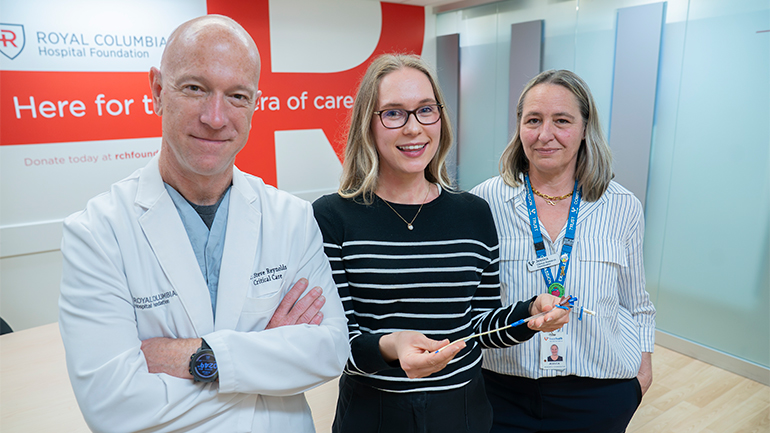
Research led by Fraser Health and Simon Fraser University (SFU) published in the Journal of the American Medical Association (JAMA) could change how hospitals worldwide care for critically ill patients.
In 2023, Karen Mueller’s daughter was critically injured when her car hit a moose and then slammed into a rock face in Ontario.
“It was astonishing to me that the two things keeping Alena alive were her airway and access to her vascular system,” says Karen, a former ICU nurse and now CEO of SterileCare.
Her company manufactures KiteLock™, a product rigorously tested in a clinical trial led by Fraser Health and SFU.
The CLiCK trial examined the use of central venous access devices (central lines) in adult intensive care unit (ICU) patients. Central lines are essential for delivering life-sustaining fluids, antibiotics and nutrition, but they can also increase the risk of infection and other complications that often require additional treatment.
To reduce these risks and to keep the catheter open when not in use, clinicians place a small amount of fluid in the lumen—or hollow tube of the catheter. This is known as a catheter lock.
In the CLiCK study, Fraser Health and SFU researchers found that adding a four per cent tetrasodium ethylenediaminetetraacetic acid solution (KiteLock™) to the catheter lumen reduced the risk of complications in ICU patients.
Nearly 1,500 patients at six Canadian hospitals, including Royal Columbian Hospital, Surrey Memorial Hospital and Burnaby Hospital participated in the clinical trial.
“Central lines are essential for many ICU patients, but complications can interrupt care and result in additional treatment, leading to longer ICU stays and additional costs to the health system. Because these lines are used in ICUs around the world, evidence on how to reduce complications can matter beyond one hospital or one health system,” says Dr. Steve Reynolds, ICU physician, Royal Columbian Hospital and senior study author. Marlena Ornowska, who was recently awarded her PhD from Simon Fraser University, led the study and is the first author.
The study was supported by several partners, including Royal Columbian Hospital Foundation and Fraser Health’s Department of Evaluation and Research Services administrative team and clinical research units.
“This study reflects Fraser Health’s role in supporting research that begins with real questions from patient care and is tested through careful clinical methods,” says Kate Keetch, director of Evaluation and Research Services. “Research is a catalyst to continuous quality improvement and innovation in the health care system.”
“I would like to thank the critical care nursing staff and acute care teams whose dedication made this study possible,” says Dr. Reynolds. “Their commitment to the study protocol in complex care environments allowed this work to move forward.”
Karen Mueller is hopeful the study will help change clinical practice world-wide. “Preventing catheter complications allows patients and families to focus on getting better rather than dealing with complications related to their treatment,” she says.
Three years after her accident, Karen’s daughter is completing a business degree and thriving.
“She had to learn to talk, eat, write, and walk again,” says Karen. “I always say she is my miracle child, although her recovery was greatly due to her determination and positive attitude.”