
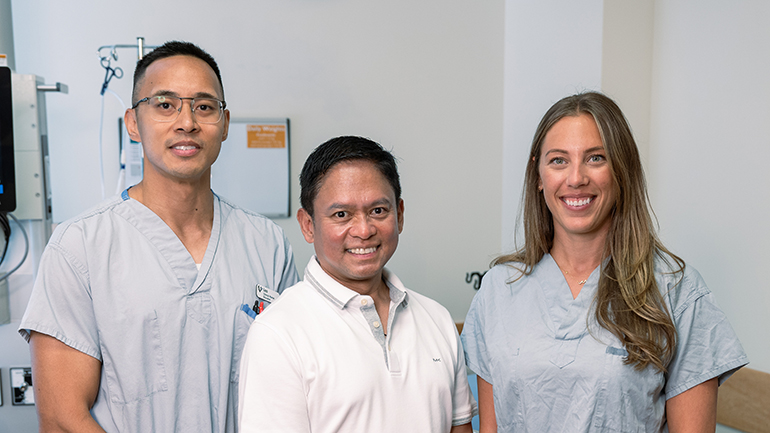
The Cardiac Surgery Intensive Care Unit (CSICU) Cardiac Advanced Life Support Team at Royal Columbian Hospital has earned an Innovator Award — a prestigious honour recognizing their life-saving work in cardiac arrest care and clinician training.
Photo (from left to right): Leo Eulalia, clinical nurse educator; Robinson Peria, patient care coordinator; and Elise Allen, patient care coordinator
As the only cardiac surgical centre in Fraser Health, Royal Columbian Hospital cares for the sickest cardiac patients in the region. Meeting this challenge demands exceptional skill, rapid decision-making and unwavering commitment — qualities that define the CSICU Cardiac Advanced Life Support Team. For them, saving lives isn’t just part of the job — it’s their purpose.
Driven to push the boundaries of care, the team introduced the Cardiac Surgical Unit Advanced Life Support (CSU-ALS) protocol — an evidence-based approach proven to increase survival rates for patients who suffer cardiac arrest after cardiac surgery.
“Our CSICU Team shares one goal: patient survival,” says Clinical Operations Manager Erin Mellios. “The strong evidence for CSU-ALS made it clear — implementing this protocol was critical.”
Elise Allen, patient care coordinator, agrees.
“Our drive to implement the program came from the chaotic and emergent nature of a cardiac arrest. Knowing there was a protocol out there that would allow for a more streamlined process, we advocated for the roll-out of this program at our site,” she says.
Learn more about the team’s inspiring work:
What is the CSU-ALS protocol, and why is it so successful?
This evidence-based protocol allows for timely re-opening of the fresh sternotomy incision to aid in early detection and intervention of the cause of the cardiac arrest. A sternotomy is a surgical procedure where the sternum (breastbone) is divided to provide access to the thoracic cavity, most commonly for open-heart surgery or other major chest operations.
In the first five to seven minutes of post-operative cardiac arrest, timely re-sternotomy — the reopening of the breastbone — can significantly improve survival by allowing for direct cardiac massage, bleeding control and electricity delivery.
“This protocol provides specific pathways to follow given the initial presentation of the post-surgical cardiac arrest,” explains Elise. “This allows our highly-skilled team to make timely decisions to re-open the freshly-closed sternum as they begin internal interventions.”
The implementation of CSU-ALS has been significant and enabled Royal Columbian Hospital to deliver the highest standard of care for patients undergoing complex cardiac surgeries. This protocol enhances outcomes for post–cardiac surgery patients because it is specifically tailored to their unique risks. As a result, survival rates increase and long-term complications following cardiac arrest are reduced.
“CSU-ALS certification has provided our team with structured, evidence-based methods that minimize errors and improve response times,” Erin shares. “This leads directly to better patient outcomes, particularly through reduced mortality during these high-risk emergencies.”
Patient Care Coordinator Robinson Peria adds: “The program really helped us improve our care and solidify our roles.”
Their passion for the program and for pursuing excellence was soon recognized.
“We were the first unit in Western Canada to certify with CSU-ALS,” Elise says. “We built our program with the support of our site and dedication from our team.”
Elise, Robinson and Clinical Nurse Educator Leo Eulalia became certified CSU-ALS trainers. After completing intensive training, they trained 90 per cent of the unit’s CSICU nurses within a year — an achievement that helped secure the Centre of Excellence designation.
Their impact didn’t stop there.
“Our trainers have since gone on to teach physicians from diverse backgrounds, outreach team members as well as our cardiac stepdown and intensive care leadership members,” Erin shares. “They are now working to expand this training both provincially and nationally.”
Leo is passionate about the protocol’s long-term impact.
“We not only train staff once but make sure that they are being recertified every two years,” he says. “With constant recertification, that contributes to us being a well-oiled machine in emergency situations.”
The team’s commitment to innovation and excellence has not only improved outcomes, but it is saving lives and setting a new standard for cardiac care in Canada.
Congratulations to the Royal Columbian Hospital Cardiac Surgery Intensive Care Unit Cardiac Advanced Life Support Team – recipient of an Innovator Award.